

Let us suppose three artists – a poet, a painter, and a composer – wish to immortalize a certain duke’s birthday.
The poet, sharpening his quill, soon sets off upon a description of the celebration: its scents, the vivid shades of countless streamers.
The painter, to whom a thorough analysis of scent and taste is denied, focuses their efforts chiefly upon the fete’s visual characteristics.
The unfortunate composer, however, unable to so immediately rouse the nostrils, tastebuds, or pupils, must rely upon an abstraction; a conceptualization of the scene. Therefore, as these sounds do not directly correspond to sounds of the initial inspiratory moment, each note and its position are the sole depositories of content.
Thus, classical art music is infrequently listened to. Lyrical genres present their content in a far more transparent manner, furnishing the audience with words to serve as semiotic signposts.
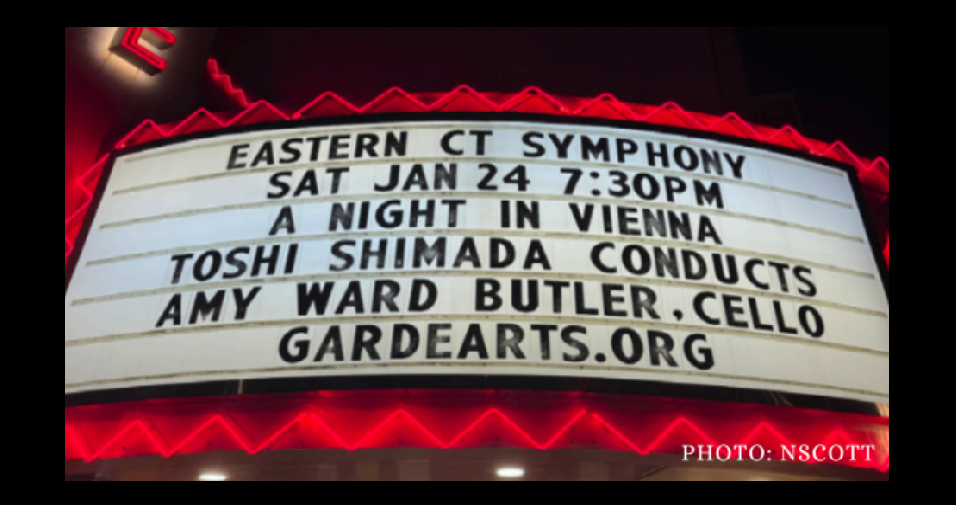
Genial in comportment and fluid in Eastern Connecticut Symphony Orchestra Toshiyuki Shimada conducting, the stage was, quite literally, set for an evening of elegance.
The night’s program, entitled “A Night in Vienna,” contained three works – Mozart’s Symphony No. 36, Haydn’s Cello Concerto in D, and Beethoven’s Symphony No. 4. Each, in some manner, either due to their composer or the circumstances of their creation, relate to that most honored capital of music.
The first, Mozart’s 36th Symphony, is reminiscent of the formal French garden: a rational elegance pervades each movement; a sense of order and reason, even in the most tempestuous of passages, reigns. Indeed, one must recall, this was the Age of Enlightenment. The conclusion adopts a grand rapidity, without once sacrificing a modicum of Mozart’s handsome sonic constructions. Continuing onwards, a thoroughly astute reading of Haydyn’s concerto was provided to rapt listeners.
Most remarkable of the piece was the soloist, one Amy Ward-Butler, Principal Cello of ECSO. From Ms. Ward-Butler’s instrument – one which is utterly at her will, infused with her passions, subordinate to her dextrous command – emerged a radiant sunbeam, sparkling throughout the theater. In turn unfurled a tender wisp of incense, richly fragrant of melancholy.
To conclude, one arrives at Beethoven’s fourth, a work, according to Mr. Shimada, often overshadowed by the favored 3rd and 5th.
Amongst the loveliest of effects a string instrument may emit is that of “pizzicato,” an Italian word for “pinched.” Rather than utilizing the bow, the violinist plucks, or “pinches,” a string to produce a short, distinctive note.
The overall result, when combined with pleasant, if mysterious, extended tones, is one of uncertainty. Nevertheless, it, as with the remainder of each piece, possesses a general air of joy, if not contentedness. The plucking cleverly serves to simply heighten the audience’s attention and arouse their interest, suggesting newfound wonders which lie ahead.
The conclusion of the piece is nothing short of a musical revelation: adventure abounds, replete with percussion and orchestral swerves, yet it is never far divorced from the sweetly strong strains of a violin.
Classical music need not be intimidating, though what is beautiful often evokes terror. My recommendation is thus: separate yourself from criticism and commentary, and simply allow the music to penetrate the furthest reaches of your mind. How wonderfully refreshing a sensation it is.