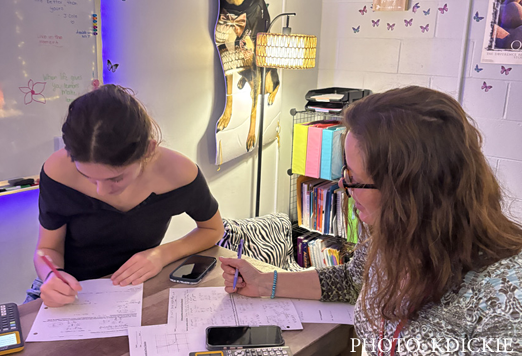
Walking into the Multi-Tiered Systems of Support (MTSS) rooms at ELHS feels different from the rest of the building.
Despite the success of the program, recent budget discussions includes possible reductions to MTSS staffing. Teachers expressed high concern that fewer staff members would mean fewer students receiving support.
“It’s kind of like a triage,” MTSS teacher and Math Specialist Kerri Legg said. “We figure out what parts students are struggling with, and address those little areas before they become bigger problems.”
The program helps students strengthen math, literacy, and executive-functioning skills through short-term study hall sessions. Teachers use grades, test scores, and referrals to identify who may benefit from extra support.
Unlike traditional tutoring, MTSS teachers say the work goes deeper than just homework help.
“We’re not just tutors,” MTSS teacher and Reading & Literacy Specialist, Sara Nazzaro said. “We’re trying to figure out what’s underneath that’s keeping students from achieving their goals.
At ELHS, MTSS includes literacy specialists, a math interventionalist, and executive functioning support teachers who work closely together to create individualized goals for students.
“It’s a highly collaborative process, with students voluntarily choosing to participate and monitor their process and meet their goals,” MTSS teacher and Reading & Literacy Specialist Kimberly Reith said.
For students looking for extra support before tests, experiencing overwhelming school days, or just simply needing a quieter place to regroup, MTSS is their “safe spot.”
“We’re kind of like second moms,” Ms. Legg said in agreement with the other MTSS teachers.
Many students agreed that the environment itself makes a difference.
“Learning in MTSS is a quieter place than a regular classroom,” sophomore Nathan Milton said. “You have options to be a lot more comfortable.”
Milton and others also said the program helped him stay on top of assignments. “It helped me personally by making sure I got my work in on time,” Milton said.
Teachers say confidence is one of the biggest changes they see in students over time.
“I can’t tell you how many times students walk in saying, ‘I hate math,’” Ms. Legg said. “Then later they’re saying, ‘I actually love math now.’”
The program has become increasingly important after COVID-19 as teachers continue seeing learning gaps.
“We need more interventionalists, not less,” MTSS teacher and Executive Functioning Specialist Jacqueline Kapusta said.
Ms. Kapusta and the other teachers work with students on organization, assignment planning, time management, emotional regulation, and communication with teachers.
Still, teachers say the heart of MTSS stays the same: making sure students feel supported, capable, and understood.
“The goal is always to help students become confident enough that they no longer need the support,” Ms. Reith said.