From homework to social media, Artificial Intelligence (AI) has become a huge part of everyone’s life, whether you’re a student, teacher, or member of the workforce. Although AI has distinct costs and benefits, the question still lingers: is AI making students smarter, or making it easier for them to cheat?
Beginning in the fall of 2026, AI will be on all school laptops throughout ELPS. Students from kindergarten to eighth grade will have access to MagicSchool, and ELHS students will be able to use Gemini. It was decided by East Lyme Board of Education (ELBOE) to allow a less-regulated program to be used by high school students; data privacy and confidentiality will remain, while also allowing for more individual freedoms. The ELBOE is incorporating these AI tools to help students improve and prepare to live in a world dominated by AI.
According to assistant superintendent Annaliese Spaziano, the main goal in implementing Gemini is to help students
develop the four skills for the vision of the graduate: communication, active learning, collaboration, and contribution. The ELBOE wants students and AI to work together. Ms. Spaziano gives the analogy that humans will be the pilot, and AI will be the copilot.
Also according to Ms. Spaziano, ELBOE believes AI can be used as a tool to support students with their learning and provide necessary guidance, rather than a substitute for critical thinking.
Furthermore, to help teachers protect academic integrity, students will be required to remain transparent with their usage of AI. Students will not be able to plagiarize, but they can use AI to help them on designated assignments. For instance, if noted as acceptable in an assignments’ directions, students can use AI to help plan their ideas or thinking in an organized manner. This way, if AI is used, it will be cited as a source, rather than blended in as a part of the student’s original thinking.
While opinions from staff and students on the idea of encouraging the use of AI differ, Principal Henry Kydd addressed the concerns, saying that AI has become an unavoidable resource and despite its unpredictability, students and teachers must learn how to coexist with it.
“There’s probably a wide variety of feelings amongst the faculty about AI: whether or not students should be using it, how students should be using it, and what it should be used for. But I think what there is agreement on is that it is going to be a part of your lives and I think it’s really important for us to start to work with [students] on how to use resources like this, ethically and responsibly,” Mr. Kydd said.
Since the surge in student use of AI over the last few years, teachers and admin could not keep up with tracking integrity in usage. The goal of the application and encouragement of properly-used AI is to help teachers assist students to move forward in this era of constantly developing technology. AI as a tool does not replace any of the necessary processes that students go through educationally. Instead, the goal is for it to facilitate academic progression and allow students to elaborate more thoroughly, combining their own ideas with those of the AI.
“There is a human piece that AI will never be able to replicate,” English teacher Kimberly Buckley said.
Although AI will be brought forth as a helpful tool, ELHS students see both the advantages and disadvantages that come with the usage of AI.
“I’ve always been the type of person who likes to figure it out myself, and I think asking AI is often a shortcut people use so they don’t have to actually learn. I don’t think AI is something you should give students freely,” junior Jessica Feng said.
Feng countered that she has used AI on rare occasions in which she struggled with difficult homework problems.
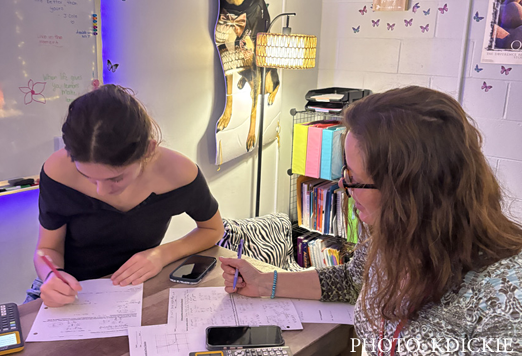
“There have been times when I’m super stuck on a physics problem and I really don’t know what to do. Instead of staying stuck on my homework and not making any progress, I can ask AI for tips and start progressing on the problem,” Feng said.
Two contradictory points can be true at once: AI can be used as a beneficial tool, but can also be used to cut corners and ideally must be kept within boundaries. There are many situations where AI will be beneficial, as well as when it is strictly prohibited and discouraged. Teachers, alongside students, will be learning much about AI and how to shape their assignments accordingly. Learning to recognize the benefits and drawbacks in both teaching and learning guided by AI is the first step to using AI for the proper, intended, and honest reasons.