For ELHS students, the words “book bannings” can feel like a foreign concept. Sure, we may hear about it on the news or in our English classes, but in our day-to-day lives, access to books is never questioned. If an ELHS student wants to read a novel, it’s there, on classroom shelves in the library, supported by teachers who encourage curiosity. For ELHS alumni Annalise McCaffrey, however, that freedom is no longer taken for granted.
“In the age of technology, it’s so difficult to motivate your students to want to read. If there’s a book that a student finds relatable to them that they want to read, it’s becoming harder and harder for them to do so in my area,
which I find extremely disheartening,” Ms. McCaffrey said.
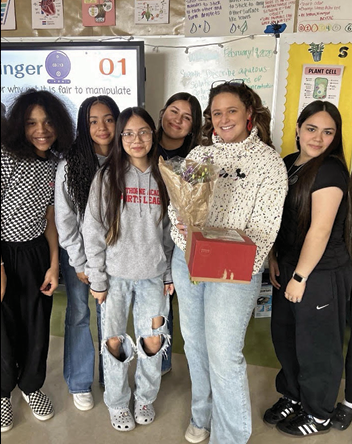
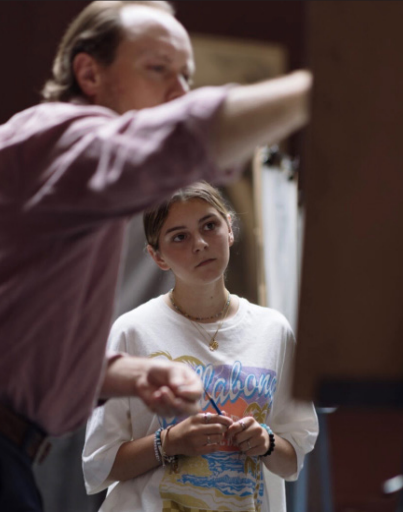
with students in her seventh and eighth
grade classroom
After graduating ELHS in 2018, Ms. McCaffrey went on to become a seventh and eighth grade science teacher in San Antonio, Texas through “Teach For America.” The program recruits college graduates to teach for two years in under-resourced urban and rural public schools to boost student opportunities and academic achievement.
Recently, Texas Senate Bill 13 impacted Ms. McCaffrey’s district by allowing parents to challenge and remove books from school libraries. The bill mandates parental access to library catalogs, and allows parents to restrict entire classes of students access to specific materials.
“It gives a lot of power to parents. I live in a historically undereducated area, so we’re asking these parents who want certain books removed, ‘have you read these books?’ And often the answer is no. They’ll hear something about profanities or the mention of sex in the book, and automatically assume it’s inappropriate… Anyone can basically argue they’re not comfortable with their student having access to this book, but then it affects the whole class,” Ms. McCaffrey said.
Some book titles deemed inappropriate include “Charlotte’s Web” for “mysticism” because animals can’t talk in real life. Others include “Harry Potter” for “wizardy.”
“My friend teaches English in the high school that my [students] go to, and she has had to fight to read ‘Romeo and Juliet,’” Ms. McCaffrey said.
For EL students who live in an area with a 91.4 percent adult literacy rate, it may be difficult to think about the impact of this censorship. But, in communities like the one Ms. McCaffrey serves, access to books is not just about enrichment, it’s essential.
“Growing up in East Lyme, we have a phenomenal foundation of literacy. As I learned, that is just not the case for most of America. 25 percent of adults in San Antonio have a literacy rate at or below a fifth grade level. While I’m teaching eighth grade, I have students who cannot read. Because of that, if there’s any book that these kids want to read, I would want to find any way to let them read it. San Antonio is so behind in literacy in the country, [the national average adult literacy rate is 79 percent] why are we going to deprive kids of reading something?” Ms. McCaffrey said.
Even in a place like East Lyme, where students may not feel the immediate effects of censorship, the long-term consequences still matter. Literature creates shared knowledge and references that connect generations of students.
“Books like ‘Romeo and Juliet’ are such classic literary pieces. Since that book has been read in high schools for generations, we could have generations of students who are going to have this gap of references. We’re not going to be able to allude to things. We’re going to lose so much through censorship,” Ms. McCaffrey said.
Still, not all students passively accept these changes. Some have responded with curiosity and defiance.
“I have passionate students who have asked me if I can print out the list of banned books so that they can go buy and read them. I love those students because they’re taught to think one way, but decide to productively rebel,” Ms. McCaffrey said.
For East Lyme students, her experience is a reminder that the freedom to read is not guaranteed everywhere. The books discussed in English classes, the ability to browse a classroom library, even the expectation that literature will be available, these are privileges that exist within a specific context.
That’s why she urges students in East Lyme to pay attention and not take reading for granted. It’s easy to assume that this could never happen in East Lyme, but it’s happening in other places, and it affects real students every day.
“I would urge everyone to never stop reading. If I could go back to high school, I would read every book more intentionally, learning all of the literary references, because now all the books that I did read with them, none of my kids do,” Ms. McCaffrey said.