VIKING SAGA: How did you start working in sports media for Connecticut? Did you begin somewhere else?
CASEY O’NEILL: My start team was in 1990 for WNLC Radio, and I was only a freshman in college. The broadcast team for WNLC Radio was doing a basketball game, and my father was actually a play-by -play broadcaster. One of the broadcasters, alongside my father, was called away for an emergency. I was sitting at the broadcast table, and when they went live, there was nobody else there. I vamped and said, ‘this is Casey O’Neill live at Waterford High School, Mr. O’Neill will be back shortly. In the meantime, let’s get ready for high school basketball…” When I sent it back to the station, the manager reached out and asked me to do sidelines radio. Then 15 years ago, The Day decided they wanted to do some live-stream events and reached out to me to take that on. We’ve been going strong ever since.
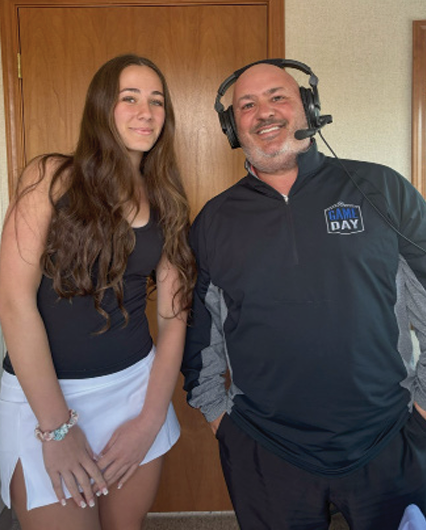
SAGA: For students who aren’t naturally comfortable on camera, how do you help them find that confidence?
O’NEILL: That is a great question. It is very important for the person that is being interviewed to feel comfortable, even if they’re not. Fortunately, we’ve been doing this long enough that most kids know what it looks like ahead of time. Sometimes it’s not live, so the first thing I tell them is if they mess up, they can start over. The goal is to have a conversation, not an interview, that our editor will later turn into something. When it is live, before we go on, I try to give the person 30 seconds of what they should expect, and tell them to answer whatever they feel comfortable with. We always want to make you look good.
SAGA: Can you tell me about any memorable moments that you’ve had with a student?
O’NEILL: There’s been a lot, but the most memorable moment I had was at the TSA. I was heading through and a worker looked at me and said ‘you’re the Game Day guy, right?’ And I said, ‘yeah’ he goes, ‘I played football, you actually interviewed me back when I played.’ You never know the impact you might have on somebody. All these years later he remembered that interaction very fondly and I think that’s probably the most satisfying thing above all. It’s those kinds of things that really stick out.
SAGA: I know you do power rankings and great 8 plays of the week, can you tell me a little bit about that process and how you go about that, how you make your decisions?
O’NEILL: There’s a reason why we do the power rankings of the sports that we do them with, and people say, “why don’t you do girls lacrosse power rankings?” We want the power rankings to be ethically sound, meaning sports that I’m able to give my opinion on because of evidence I’ve gathered, viewing them myself, and coaches that I’ve talked to. So, for example, baseball is the power rankings we’re doing currently because I’m plugged into baseball. I want to make sure that the sports rankings that we do are based on firsthand knowledge. I pay attention every day to what’s going on in that specific sport. I follow every team on their social media that I can. I get a feel for what’s going on, and I talk to coaches during the course of the week. We come up with the power rankings, Peter Huoppi and I, based on all of the information that we have. With the Great 8, Peter sometimes gets 25 clips submitted a week, and we have to narrow it down to eight. We watch them together, and we have criteria that we use, and we also try to highlight sports that we don’t see often and give them recognition. It’s very much a team effort.
SAGA: What do you think that students bring to storytelling that professionals don’t?
O’NEILL: This is something that we talk about a lot. High school students in particular are still new to the concept of being put on camera and interviewed. So there’s a very genuine joy, excitement, and honestly, that comes with high school sports. Their reactions are genuine, and their answers to questions are honest. As you get up into the professional ranks, everyone’s interview is very polished. It feels like everything that they say is designed for a specific purpose. High school feels authentic. It is important to remember that some of these are 15 year olds; students who may have never been on camera before, and have never experienced coverage before. There’s a responsibility there, too, to make sure that we’re protecting them. We don’t look to protect professionals, since it’s their job, but it’s very important to protect high school kids because it’s new to them. So sometimes, when they’re being genuine, maybe it’s not putting them in the best light. Sometimes we get a little trash talk, or I can get a kid who’s reaction might seem a little over the top at someone’s expense, so we try to make sure we don’t show that side of it. We’re always trying to show the genuine joy and honesty of high school games.
SAGA: Is there anything else about your work with students that people wouldn’t guess from the outside?
O’NEILL: I don’t know that everyone knows how much we agonize internally over the decisions we make. We wish we could cover every sport, every kid, all the time. Another thing is that we’re fans, too. I’m a parent, my son just graduated as a two- sport athlete, playing football in college. Like, I’m a fan. I still know a lot of the kids and a lot of the sports. I want everybody to succeed and do their best, and I’m happy to be able to be a part of it. This is the most rewarding thing I’ve ever done. To be able to get to know these kids and their families and can help promote all of the great achievements that they have; it’s a wonderful experience.