
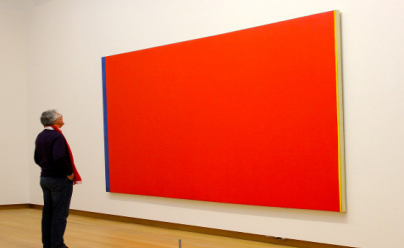
In 1986, Gerard Jan van Bladeren – an unemployed Dutchman staunchly opposed to abstraction – entered a gallery of the Stedelijk Museum wielding a knife. Fortunately, the object of his fury was not a person, but a painting: namely, Barnett Newman’s “Who’s Afraid of Red, Yellow, and Blue III.”
Tried for his misdeed, his lawyers boldly declared the painting was in fact deserving of damage: a remarkable case in point of non-figurative art’s curious relevance for those who decry it as devoid of all meaning and therefore irrelevant.
Three colors, it appears, strike to the very root of one’s conceptions of art. It is an inherent aspect of human nature to fear that which contradicts definitions maintained as if unchangeable.
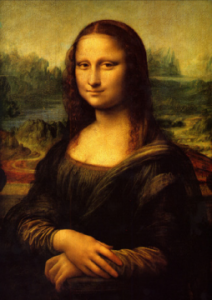
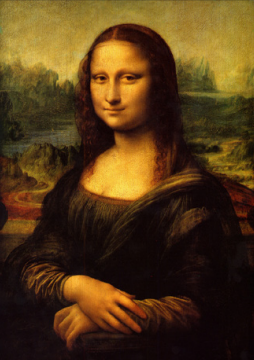
Let us momentarily consider history. Giotto, for instance, frescoed the glorious Chapel of the Arena to illuminate the life and times of St. Francis. It is probable his chief aim was the inspiration of worshippers to new heights of piety. As the Renaissance dawned upon a slumbering Italy, humanism appeared: the Mona Lisa, perhaps the crowning achievement of that era’s gorgeous flowering, is hardly spiritually instructive.
This is to say, a moral in the vein of the Medieval is not easily extracted. Rather, the Mona Lisa is a record of aesthetic
sublimity, beauty transfixed within a canvas for an inspiration of an entirely different sort. Renaissance masterworks of this type widened the possibility for the involvement of the viewer. The first viewers of Da Vinci’s work walked paths of yet untrodden intellectual stimulation, freed to wander within the wider bounds such visual stimuli aroused. The spirit of art walks ever forth into distant lands.
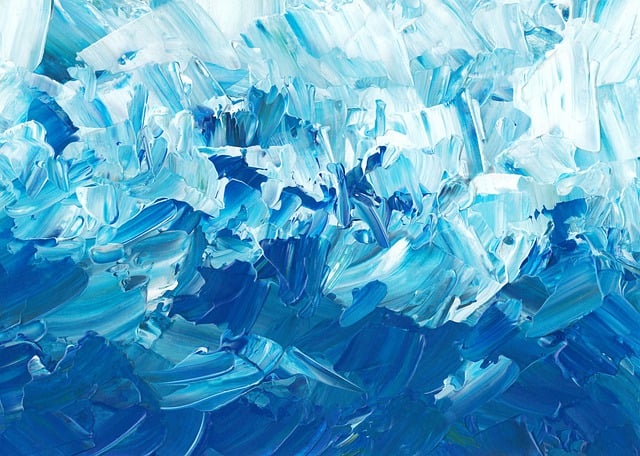
This said, for centuries, the majority of visual art provides one a comparatively obvious, neatly maintained interpretive avenue; when we speak of “modern” art, we speak of an art of invitation, of a delicious adventure welcoming us into a wood marked merely by signposts, encouraging journeys within the splendid wilderness of memory and sense. It is a adventure unencumbered by illusion.
To some, confronted with works of an abstract variety, the viewer is confronted with nothingness: with their own finitude and utter insignificance. I prefer, when applicable, a less pessimistic attitude. For concomitant with this obliteration of narrative singularity is a joyous liberation: a freedom to soar unencumbered by prejudice or preconception upon the winds of memory, sense, and pure, unshackled thought, freed from the impediment which is a monolithic meaning.
In spite of the simplicity of its form, “Who’s Afraid” is nothing short of arresting: viewers may scorn or mock as they please, yet this merely is to the merable questions may be raised, and a fresh look into the forest crystallizes anew.
-
Da Vinci’s ‘Mona Lisa,’ painted in 1503
-
Piet Mondrain’s compositions in 1937