
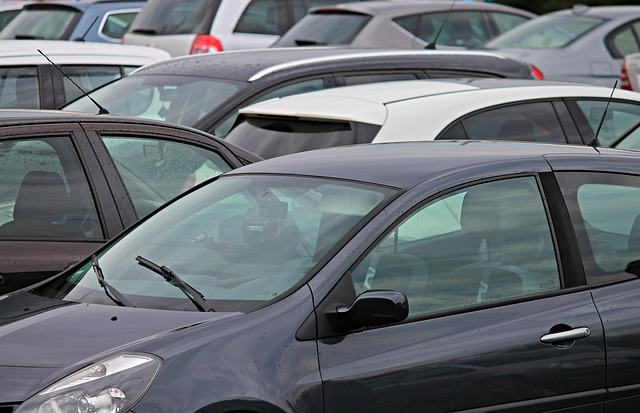

The junior parking lot has become a daily source of stress for many students, as congestion, limited space, and safety concerns continue to shape the experience of driving to school. What should feel like a step towards independence instead feels unnecessarily frustrating, turning a simple routine into a daily hassle of circling for the perfect spot, waiting in long lines, and navigating a crowded exit at the end of the day.
For many juniors, getting a parking pass is a milestone. However, that excitement fades pretty quickly once they experience the reality of the lot. With hundreds of student drivers arriving at the same time, the space doesn’t just feel crowded – it feels poorly balanced, especially just after school gets let out.
ELHS Director of Safety and Security, Don Hull, says the issue largely comes down to the number of cars on school grounds.
“We’ve given out about 260 [parking passes], now,” Officer Hull said, noting that the total number of parking spaces
across student lots is only slightly higher. This imbalance contributes directly to the congestion students face each day.
Despite frustrations, school officials emphasize that safety remains the top priority. One of the most noticeable efforts to improve safety has been the addition of speed bumps throughout the entrance of the junior lot and around Flanders Elementary School. While some students question their placement, the reasoning behind them is straightforward.
“They started with the speed bumps around seven years ago, just because of the speeding. And it’s not just students – it’s parents, too,” Officer Hull explained.
Even if they can feel excessive at times, the speed bumps are one of the few changes that clearly serve a purpose.
The speed bumps are part of a broader effort to control traffic across both ELHS and Flanders Elementary School. Because they must be removed in the winter for snow plowing and reinstalled in the spring, they often spark confusion each year when they reappear. Still, their purpose remains the same: slowing drivers down in a crowded
and active area.
Another major point of frustration for students is the chain blocking the main entrance during dismissal. I had thought that having a security guard lift the chain after the buses leave made sense. However, according to Officer Hull, the situation is more complicated than it appears.
“We’ve kind of looked at that. But the problem we have is [elementary] parents show up 40 minutes early, and they get in that pickup line and they race through this parking lot,” Officer Hull said.
Because the school grounds are shared with the elementary students, opening the exit too early could create even more chaos, not less.
Attempts to direct traffic more efficiently have sometimes created problems elsewhere.
“The minute we stop traffic to get everybody out of the high school, Flanders Four Corners becomes a disaster. [The chain] isn’t a great solution, but it is our best solution for now,” Officer Hull said.
Safety concerns extend beyond traffic flow. One of the most common causes of accidents in the lot is something students may not think much about: how they park.
“Backing out is where we have 90 percent of our accidents. If everybody backed in in the morning, it would reduce our accidents dramatically,” Officer Hull said.
While most incidents are minor, they highlight how small changes in behavior could make a significant difference.
Weather conditions can also make the situation worse, during the winter months, snow can reduce the number of available parking spaces.
“We lose about 20 spots sometimes,” Officer Hull noted, which further increases competition for parking and adds to daily frustration.
Even with these challenges, Officer Hull believes the situation is managed relatively well given the circumstances.
“When you look at how many kids are parking out there every single day, we might have a dozen accidents a year, and they’re very minor,” Officer Hull said. “I think that’s pretty good.”
Ultimately, the biggest issue may not be the lot itself, but the sheer number of cars coming in and out of campus each day: “Too many cars, not enough pavement – that’s kind of the theory here,” Officer Hull explained. While long-term solutions, such as potential future construction of a new high school, could improve the layout and traffic flow, there are limited options in the short term.
For now, students, staff, and parents must continue to navigate the system as it is, while it may not be perfect, school officials maintain that safety and efficiency are being balanced as best as possible. As Officer Hull put it, “Based on what we have, I think we manage it very well.”